Window problems are one of the most common issues sellers discover right before listing. A few failed double-pane units, a painted-shut bedroom window, or rotting wood frames around the sills: none of these feel catastrophic, but each one can stall or kill a financed deal. What happens next depends heavily on how the buyer intends to pay.
Selling a house with window problems? Compare cash offers from buyers who price it in.
Enter your property address to get competing offers from verified cash buyers. No repairs, no agent fees, and you pick the closing date.
Prefer to talk? Call (804) 361-7460
What counts as a window problem that affects the sale
Not every imperfect window creates a transaction problem. The issues that actually affect a sale fall into two groups: those that block lender financing, and those that reduce buyer appeal but rarely stop a conventional deal.
Problems that block FHA and VA financing:
- Broken or cracked glass in any pane
- Bedroom or egress windows that cannot be opened (painted shut, broken hardware, swollen frames)
- Rotting frames with visible moisture damage or structural deterioration
- Windows that fail to latch or lock in sleeping rooms
Problems that reduce buyer appeal but rarely generate a lender condition on conventional loans:
- Failed insulated glass units (IGUs): the two panes have lost their seal and fogging has formed between them
- Single-pane aluminum frames in climates where drafts and energy bills matter
- Cosmetic damage to trim, screens, or hardware that does not affect operation
The distinction matters because the fix is different. Failed IGUs are a cosmetic and comfort issue. Broken glass in a sleeping room is a health and safety flag that government-backed loan appraisers are required to note and document.
When window problems trigger a lender condition
FHA loans follow HUD Minimum Property Standards. VA loans follow the Department of Veterans Affairs Minimum Property Requirements. Both programs instruct appraisers to flag property conditions, not just estimate value, and window defects appear explicitly in both sets of standards.
The items that generate a mandatory repair condition under FHA and VA rules include broken or missing glass, sleeping room windows that cannot be opened for egress, and frames where rot or moisture damage has spread to the surrounding structure. When an appraiser flags one of these, the lender will not fund the loan until the condition is cleared, documented, and re-inspected.
This holds even if the purchase contract says as-is. An as-is contract limits the seller’s voluntary obligation to repair. It does not override a lender’s minimum property requirements. A buyer using FHA or VA financing has no way to waive an appraiser-flagged health and safety item. The repair must happen before the loan closes, regardless of what the contract says.
Conventional loans give appraisers more discretion. A fogged IGU on a conventional appraisal is unlikely to generate a condition. A broken pane in an accessible bedroom probably will. The practical result: a seller with broken glass or painted-shut egress windows is not truly selling as-is to financed buyers. The lender will require the repair before closing, one way or another.
Disclosure duty and window defects
Every U.S. state requires sellers to disclose known material defects. Failed IGUs that are visibly fogged are a known defect if the seller is aware of them. Rotting frames are a known defect. Bedroom windows that have been painted shut are a known defect. None of that changes when the seller lists as-is.
As-is means the seller does not want to be asked to repair. It does not exempt the seller from disclosing what they know. A buyer who discovers after closing that windows were fogged, painted shut, or rotting in ways that were not disclosed has a disclosure claim in most states. The exposure is usually larger than the cost of disclosing upfront and letting the buyer decide.
One thing worth knowing: if rotting window frames have allowed moisture to reach the interior walls, that is no longer just a window problem. It is potential structural or mold damage, and it carries its own separate disclosure obligation. An inspection before listing surfaces what is actually known, which is the seller’s best protection against a post-closing claim.
Three paths for selling a house with window problems
Most sellers with window defects choose one of three approaches. Each trades off differently on price, time, and certainty. A full comparison between cash offers and a traditional listing covers the broader picture if the window issues are part of a wider condition problem.
| Path | What the seller does | Best for | Key risk |
|---|---|---|---|
| Fix before listing | Repair or replace problem windows, then list at full market price | House otherwise in good shape; seller has time and repair funds | Window replacement ROI is modest; retail price is not guaranteed |
| List as-is with buyer credit | Price below market or offer a closing credit to cover repairs | Conventional buyers; sellers who need to preserve cash before closing | FHA or VA appraiser can still flag issues before the credit is applied |
| Sell to a cash buyer | Accept offers with no lender, no appraisal, and no repair conditions | Sellers who cannot fund repairs or need to close quickly | Offers come in below market; getting multiple offers is what limits this gap |
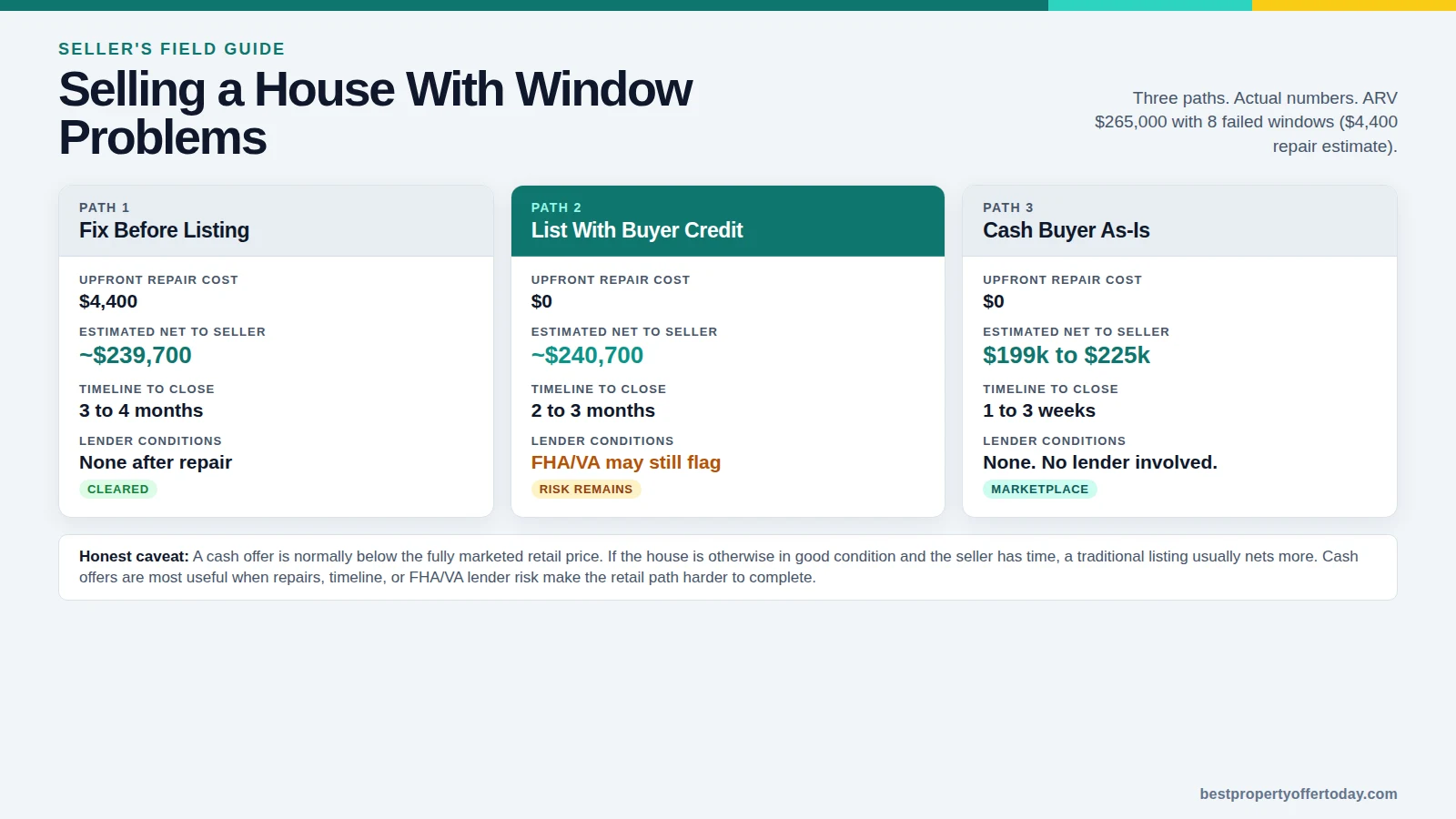
Worked example: a $265,000 ARV house with eight problem windows
The house is a 1980s colonial. Appraised replacement value: $265,000. Six double-pane IGUs are visibly fogged. Two bedroom windows are painted shut. No other significant defects. The seller has received a quote of $4,400 to replace all eight units.
Run your own numbers in the net proceeds calculator. The three paths below show the mechanics.
Path 1: Replace the windows, then list retail.
Repair cost: $4,400. Listing agent commission at 5.5 percent of $265,000: $14,575. Seller closing costs: $2,900. Carrying costs during repairs and the sale period (about 3 months at $1,150 per month for mortgage, taxes, and insurance): $3,450. Estimated net to seller: approximately $239,700.
Path 2: List as-is with a $4,000 buyer credit.
No upfront repair cost. The buyer receives a $4,000 credit at closing, reducing the effective price from $265,000. Commission at 5.5 percent: $14,575. Seller closing costs: $2,900. Carrying costs over a 2.5-month sale period: $2,875. Estimated net: approximately $240,700. Similar to Path 1, but the seller keeps $4,400 in cash upfront rather than spending it on repairs. The risk: an FHA or VA appraiser may still flag the painted-shut bedroom windows before closing, generating a mandatory repair condition that puts the seller back into the same position anyway.
Path 3: Cash buyer through a marketplace.
Cash buyers on a house with manageable but visible defects typically offer 75 to 85 percent of ARV. On a $265,000 ARV house, that range is $199,000 to $225,000. Seller closing costs are minimal and sometimes covered by the buyer. No commission, no repair cost, no carrying time. Net to seller: approximately $199,000 to $225,000, depending on which offer is accepted and who covers closing costs.
The gap between Path 1 or 2 and Path 3 is roughly $15,000 to $40,000 in this example. What Path 3 offers in return is speed (1 to 3 weeks to close), no lender conditions, and no risk of a buyer walking after an appraisal flags the windows. The honest caveat: if the house is otherwise in good shape and the seller has time, a traditional listing usually nets more. Competing cash offers from a marketplace are most useful when repair scope, timeline, or lender exposure make the retail path harder to rely on.
Red flags when a buyer pushes hard on window costs
Window problems attract a recognizable pattern from certain buyers. Three situations worth knowing:
- The fogged windows were visible in the listing photos. The buyer made an offer. After the inspection, they produced a report claiming $14,000 in window and moisture damage. That number does not match any reasonable repair estimate for eight IGUs. The inspection is being used as a renegotiation lever, not as a good-faith cost assessment.
- A so-called cash buyer submits an offer with a 21-day inspection period, a $500 earnest money deposit, and an assignment clause. A buyer intending to close does not need three weeks to inspect a house or the right to hand the contract to someone else. This is a wholesaler holding the deal while searching for an actual buyer.
- The offer came in at $255,000. After the inspection period ends, a price reduction to $243,000 is requested, attributed entirely to window issues that were disclosed before any offer was made. A number that drops after contract on a disclosed defect is a bait-and-switch.
Knowing what to look for in the offer itself is the first line of protection. The guide to spotting a legitimate cash home buyer covers proof of funds, earnest money norms, and other signals. Having multiple competing offers on the table also limits this kind of leverage: it is much harder to cut $12,000 from a price when the seller has two other offers within $5,000 of each other.
Questions to ask before accepting any offer on a house with window issues
Bring these to any conversation with a buyer or agent before signing:
- Are you using FHA or VA financing? If yes, window conditions disclosed in the listing may still generate a mandatory repair condition from your lender’s appraiser.
- If you are making a cash offer, will your price change after the inspection? A genuine cash buyer prices the house based on its disclosed condition, not a number that drops post-contract.
- What documentation can you provide that the funds to close are yours? (See the proof of funds guide for what counts and what does not.)
- Is there an assignment clause in your contract? A right to assign the deal to another buyer extends closing timelines and signals the buyer may not intend to close themselves.
- Who pays closing costs in your offer? On a cash deal, this is negotiable and affects your actual net.
Ready to see real numbers for your house?
Enter your property address to get competing offers from verified cash buyers. No repairs, no agent fees, and you pick the closing date.
Prefer to talk? Call (804) 361-7460
Frequently asked questions
Do I have to fix windows before I can sell my house?
Not if you are selling to a cash buyer. Cash buyers do not use lenders, so there is no appraisal and no minimum property standards review. You can sell as-is with no repairs. If you are selling to a buyer using FHA or VA financing, broken glass and painted-shut egress windows may generate a mandatory repair condition from the appraiser. Those repairs must happen before the lender funds the loan, regardless of what the purchase contract says about as-is.
Will fogged double-pane windows fail a home appraisal?
Probably not on a conventional loan. Conventional appraisers primarily estimate value, and fogged IGUs are a common cosmetic issue most appraisers leave to buyer negotiation. FHA and VA appraisers apply stricter property standards. Fogged windows alone are less likely to be called out as a repair condition than broken glass or a bedroom window that cannot be opened, but it depends on the appraiser and the severity. Broken glass is the clearest automatic flag under both programs.
Can I disclose window problems and still sell as-is to a financed buyer?
You can disclose and list as-is, but the buyer’s lender is a separate party with its own requirements. Disclosing the defect to the buyer does not prevent the lender’s appraiser from flagging it. If the appraiser calls out broken glass or a non-operational egress window, the repair must happen before the loan closes. The seller can make the repair, the buyer can seek a credit to cover it, or the deal falls apart. Disclosure protects the seller legally. It does not stop the lender condition from arising.
How much does window replacement actually cost before selling?
IGU glass-only replacement, where just the glass insert is swapped without touching the frame, typically runs $150 to $400 per unit installed depending on size and local labor rates. Full-frame replacement, where the entire window unit is removed and replaced, runs $600 to $1,500 per window. A house with 12 to 15 windows needing replacement can reach $9,000 to $20,000 or more. The annual Cost vs Value report puts window replacement ROI at roughly 67 to 70 cents per dollar spent in added resale value. Replacing windows before a retail sale is often a cost-recovery exercise, not a profit generator. For a seller with only a few flagged windows, replacing those specific units is usually more practical than replacing the whole house.
To request competing offers on your property with no obligation, call 804-361-7460 or submit a property request above.