Paperwork for Selling a House by Owner: The Complete Checklist
Selling without an agent saves the commission, but it also means the paperwork is yours to manage. Miss a required disclosure and you can face legal exposure long after closing. Here is the paperwork for selling a house by owner in 2026, organized by stage, so nothing surprises you.
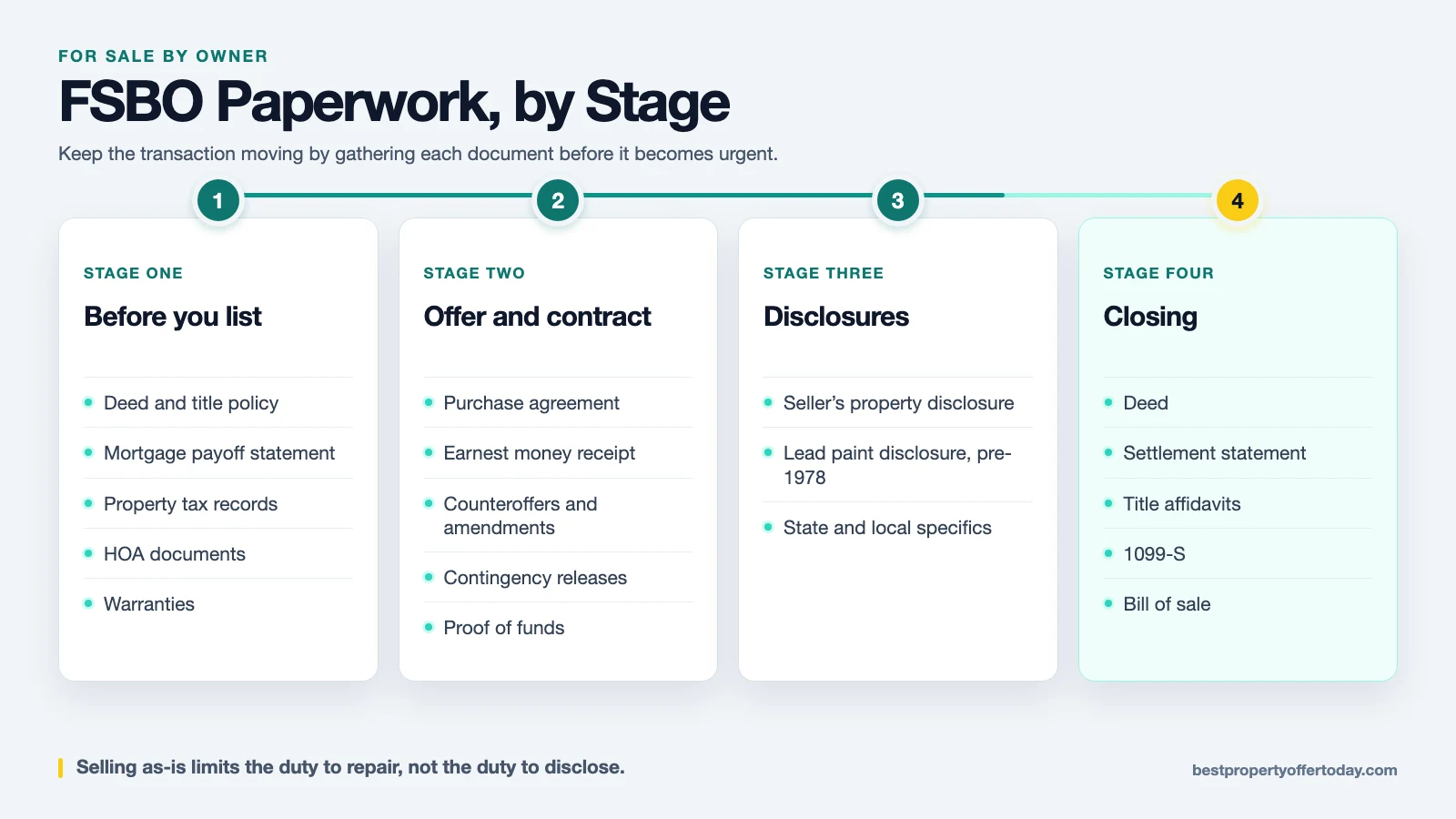
Before you list your house
- Original purchase documents. Your deed, title insurance policy, and the settlement statement from when you bought. These establish what you own and any exceptions on title.
- Mortgage payoff statement. Request this from your lender. It states the exact amount, with per diem interest, needed to release their lien.
- Property tax records. Current bill and payment status. Buyers and title companies will prorate taxes at closing.
- HOA documents. If applicable: covenants, bylaws, current dues, and a statement that you are current. Many states set deadlines for delivering these once under contract.
- Utility records and warranties. Average utility costs, plus warranties or manuals for the roof, HVAC, water heater, and appliances that convey.
- Pre-listing inspection report (optional). Not required, but it prevents surprises and signals good faith to a nervous FSBO buyer.
- Survey or plat, if you have one. Useful when fences, driveways, or outbuildings sit near a boundary. Some title companies will require a new one if encroachments show up.
Offer and contract stage
- Purchase agreement. The core contract: price, earnest money, financing terms, contingencies, closing date, and what conveys with the home. Most states have standard forms; many FSBO sellers pay a real estate attorney a few hundred dollars to review this one document. It is money well spent.
- Earnest money receipt. Documents the buyer’s deposit and who holds it, usually a title company or attorney, never you personally.
- Counteroffer and amendment forms. Every change after signatures needs a written, signed amendment. Verbal agreements do not exist in real estate.
- Contingency removal forms. As the buyer clears inspection, appraisal, and financing contingencies, get each release in writing.
- Proof of funds or pre-approval letter. Collect this before you take the home off the market, not after. A pre-qualification is not a pre-approval, and neither is a commitment to lend.
Disclosures (where sellers get sued)
- Seller’s property disclosure. Nearly every state requires a written form covering known defects: roof, foundation, water intrusion, systems, pests, and more. Answer honestly. “I did not mention it” is how FSBO sellers end up in court.
- Lead-based paint disclosure. Federal law for any home built before 1978, with the EPA pamphlet and a 10 day inspection window for the buyer.
- State and local specifics. Depending on where you live: natural hazard zones, flood plains, radon, wells and septic, solar leases, or death on the property. Check your state’s requirements; this is the most state-specific part of the process.
One clarification that trips up as-is sellers. Selling as-is limits your obligation to repair. It does not limit your obligation to disclose. Those are separate duties in nearly every state, and the disclosure duty survives the closing.
Closing the Sale Step by Step
- Deed. The new deed transferring title, prepared by the title company or attorney and signed before a notary.
- Settlement statement. The line by line accounting of money in and out. Check the payoff, prorations, and fees before signing day.
- Title documents and affidavits. Owner’s affidavit, lien waivers for recent work, and whatever the title company needs to insure clean title.
- 1099-S and tax records. Keep everything for your tax return; primary residence exclusions cover many sellers, but you need the paper trail.
- Bill of sale. For personal property conveying separately, such as a washer, dryer, or riding mower.
- Keys, codes, and warranty transfers. Garage remotes, gate and alarm codes, and any transferable roof or termite warranty.
Who actually prepares each document
FSBO sellers often assume they have to draft all of this. They do not. Most of it is produced by the closing professionals once you are under contract.
| Document | Who prepares it | When |
|---|---|---|
| Purchase agreement | You, from a state approved form, ideally reviewed by an attorney | At offer |
| Seller’s disclosure | You, personally. It cannot be delegated | Before or at offer |
| Lead paint disclosure | You, using the federal form and EPA pamphlet | Before contract is binding |
| Title search and commitment | Title company or closing attorney | After contract |
| Payoff statement | Your lender, requested by the closing agent | Two weeks before closing |
| Deed | Title company or attorney | Days before closing |
| Settlement statement | Closing agent | Delivered before signing |
| 1099-S | Closing agent | At or after closing |
What the paperwork actually costs
Doing FSBO properly is not free, and the fees are worth knowing before you decide the commission savings are pure profit. Expect an attorney review of the contract and disclosures in the range of 300 to 800 dollars, notary fees, recording fees set by your county, and a title policy whose cost depends on price and on local custom about who pays. In much of the country the seller also still pays a commission to the buyer’s agent if the buyer brings one, which is where a large share of expected FSBO savings quietly goes.
The FSBO paperwork mistakes that sink deals
Three patterns cause most FSBO problems: using a purchase agreement from a random website that does not match state law, holding earnest money personally instead of in escrow, and treating the disclosure form as a marketing document instead of a legal one. An attorney review of your contract and disclosures typically costs 300 to 800 dollars, which is cheap insurance against all three.
A fourth is quieter and just as costly: letting a buyer occupy the property before closing. Pre-closing possession turns a failed sale into a tenancy question, and in some states removing that person becomes an eviction rather than a cancelled contract.
Common questions sellers ask
Do I need a real estate attorney to sell FSBO?
Several states require an attorney at closing. Everywhere else it is optional, but a single review of the purchase agreement and your disclosures is the highest value few hundred dollars in the whole process.
Can I write my own purchase agreement?
You can, and it is the most common way FSBO deals go wrong. Contract law here is state specific, and generic online templates routinely omit required state language and disclosure timelines. Start from your state’s standard form.
Who holds the earnest money?
A neutral third party, normally the title company or closing attorney. Holding it yourself creates a conflict and, in some states, a licensing problem.
How long does a FSBO closing take?
With a financed buyer, expect roughly 30 to 45 days from signed contract, driven by underwriting and the appraisal. A cash buyer can close in one to two weeks because there is no loan file to clear.
A simpler alternative when the paperwork is not worth it
If you are selling FSBO mainly to avoid the commission, it is worth knowing that a cash sale removes most of this stack entirely. A serious cash buyer works from a short contract, buys as-is with minimal contingencies, and the title company handles the rest. There is no financing paperwork, no appraisal, and closing can happen in a week or two. You can compare competing cash offers for your home for free and weigh them against the FSBO route, and our net proceeds calculator will show the actual dollar difference once your time and costs are counted. If you go the cash route, read how to vet a cash buyer first.
That is a genuine trade, not a free upgrade. A cash offer is normally below a fully marketed retail price. What you buy with the difference is speed, a much shorter document stack, and the removal of the financing and appraisal risk that causes most FSBO contracts to fall apart.