Yes, you can sell your parents house after they die, but the process depends on how the property was titled and whether it needs to go through probate. Here is a straightforward breakdown of what to expect and how to move forward as quickly as possible.
Who Has the Right to Sell the House?
When a parent passes away, the right to sell their home depends on how ownership was structured. The most common scenarios are:
- Will with probate: If your parent left a will, the estate must go through probate before the home can be sold. The executor named in the will has legal authority to manage and sell the property.
- No will (intestate): Without a will, the court appoints an administrator. Heirs are determined by state law, and all parties must agree to the sale.
- Joint tenancy or TOD deed: If the home was titled with a survivorship right or transfer-on-death deed, ownership passes directly to you without probate.
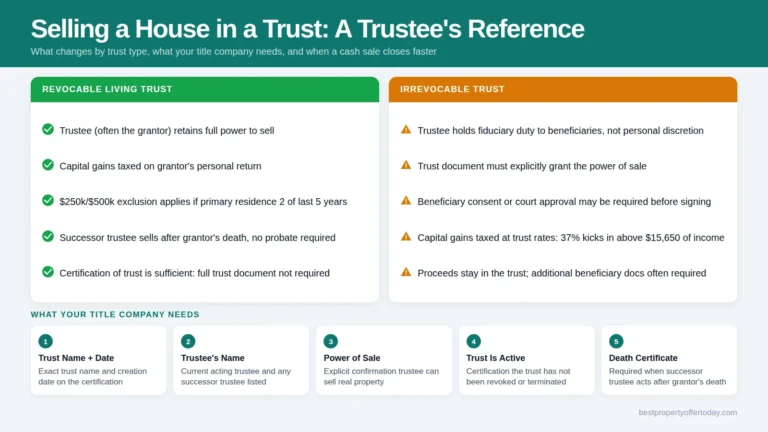
- Living trust: If the home was held in a living trust, the successor trustee can sell immediately without probate court involvement. What the trustee needs to bring to closing and how trust type affects the tax treatment covers the full process.
What Is Probate and How Long Does It Take?
Probate is the legal process of validating a will and settling an estate. It is handled by a probate court in the county where your parent lived. Depending on the state and complexity of the estate, probate can take anywhere from a few months to over a year.
During probate, you typically cannot sell the home without court approval, unless the executor has independent administration authority, which many states allow and which speeds things up considerably.
A cash buyer with probate experience can work alongside your attorney to make the sale as smooth and fast as possible, even while the estate is still being settled.
Steps to Sell Your Parents House After They Die
1. Determine how the property is titled. Pull the deed from your county recorder website or office. This tells you whether probate is required.
2. Open probate if needed. Work with a probate attorney to file the necessary paperwork and get appointed as executor or administrator.
3. Get the property appraised. An appraisal establishes fair market value and is often required by the court before approving a sale.
4. Get a cash offer. A cash buyer can provide an offer quickly, and many are experienced working with estate sales and probate timelines. Get your free cash offer to understand what the property is worth without committing to anything.
5. Get court approval if required. In many probate cases, the court must approve the final sale price. Your attorney handles this step.
6. Close and distribute proceeds. After closing, the proceeds are distributed to heirs according to the will or state law.
Can You Sell Without Going Through Probate?
Yes, in certain situations. If the home was held in a living trust, had a transfer-on-death deed, or was jointly owned with right of survivorship, the property passes directly to the heir without court involvement. In these cases, you can sell the home relatively quickly after the parent passes, once you provide a death certificate and any required affidavits.
Why a Cash Sale Is Often the Best Option for Inherited Homes
Inherited homes often need repairs, may be located far from where heirs live, or may have emotional weight that makes a drawn-out listing process difficult. A cash buyer offers:
- No repairs or cleanouts required, sell as-is
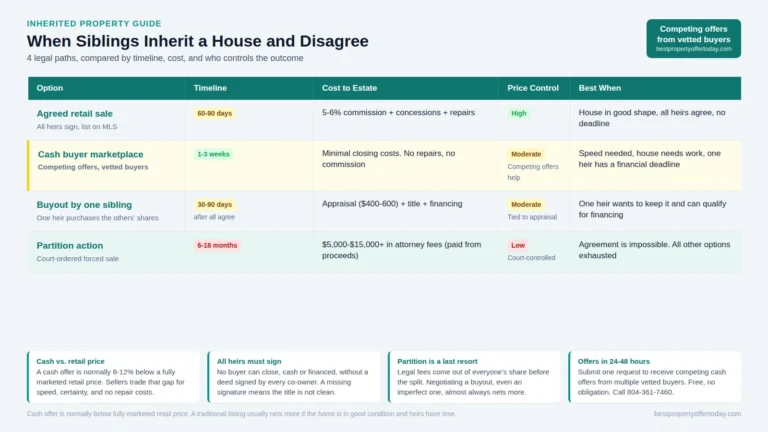
- Fast closing that works around probate timelines
- No agent commissions reducing the estate proceeds
- A single point of contact instead of coordinating showings and negotiations
You can also read our full guide on selling a probate house or browse more resources for estate and inherited property sales.
Get Your Free Cash Offer Today
If you are dealing with a parent’s home and want to understand your options, we are here to help. Best Property Offer Today buys inherited homes as-is, with no repairs, no commissions, and no pressure.
Compare cash offers today and take the next step at your own pace.
Frequently Asked Questions
Can I sell my parents house while probate is still open?
In many states, yes, with court approval or if the executor has independent administration authority. A probate attorney can confirm what applies in your state.
Do all heirs have to agree to sell the house?
If there are multiple heirs, all must agree to the sale, or a court can be asked to order one. A cash buyer can help facilitate a quick resolution when everyone is on the same page.
What happens to the mortgage when a parent dies?
The mortgage does not disappear, it becomes a liability of the estate. Payments must continue until the home is sold or refinanced. Selling quickly can prevent the estate from falling behind.
How is the sale price determined for an estate property?
An appraisal or comparative market analysis is typically used. Probate courts may require a formal appraisal before approving a sale price.
How long does it take to sell an inherited house?
It depends on whether probate is required and how complex the estate is. With a cash buyer, the actual closing can happen in as little as 7 to 14 days once you have legal authority to sell.