When you’re selling a house quickly, Offerpad and Opendoor promise a fast, hassle-free process. But the truth is more complicated than their marketing suggests. Both iBuyers make money by taking a cut of your home’s sale price, which means your proceeds are smaller from the start. Before you choose either one, it’s worth understanding what you’re actually paying and what a better alternative looks like.
How Offerpad and Opendoor Make Money
Both companies use a similar business model: they buy your house, hold it for a few months, make repairs if needed, then list it on the traditional market. Their profit comes from the spread between what they pay you and what they sell it for later. That margin is built into everything they offer.
Here’s where their fees kick in:
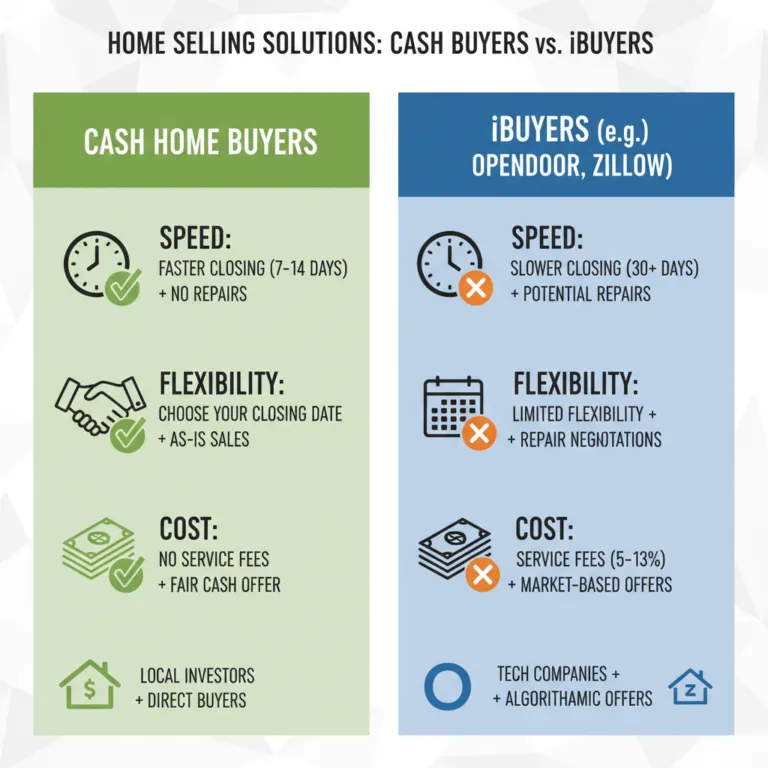
- Service fee: Typically 5-8% of the home’s sale price (Offerpad avg 6%, Opendoor 5-7%)
- Repair and improvement costs: Deducted from your proceeds if they decide your house needs work
- Holding period premium: You’re paying the buyer to hold your equity while they market and resell
- Closing costs: Title insurance, escrow fees, and other standard costs still apply
On a $300,000 home, a 6% service fee alone costs you $18,000. That’s $18,000 that goes to shareholders, not to you.
Offerpad Fees vs Opendoor Fees
The math matters when you’re comparing the two. Offerpad and Opendoor operate in different markets with slightly different economics, but the net effect is nearly identical.
Offerpad typical scenario:
- Initial offer: $300,000 home
- Service fee (6%): -$18,000
- Repairs and improvements: -$5,000-$15,000 (varies)
- Closing costs and carrying: -$2,000-$4,000
- Your net proceeds: ~$265,000-$275,000
Opendoor typical scenario:
- Initial offer: $300,000 home
- Service fee (5-7%): -$15,000-$21,000
- Closing costs and holding: -$2,000-$4,000
- Your net proceeds: ~$275,000-$283,000
Both leave you with significantly less than the original offer price. Neither provides transparency on exactly how much you’ll actually pocket until late in the process.
Speed and Closing Timeline
Both Offerpad and Opendoor claim fast closing times. In practice, it usually takes 3-7 days for an initial inspection and offer, then another 1-2 weeks for the actual closing. That’s faster than a traditional 30-60 day listing, but not dramatically so.
The catch: once they own the home, you’re waiting months for them to resell it. If they can’t flip it quickly, you’ve already lost money on service fees and have no control over the outcome.
When iBuyers Make Sense
Offerpad and Opendoor work best if:
- You need to close in 2-3 weeks and have no other options
- Your home is in a high-demand market where it will resell quickly
- You want guaranteed closing with zero contingencies
- You don’t want to deal with repairs or inspections yourself
But even then, you’re paying 5-8% to avoid typical real estate hassles that take weeks, not months.
Why a Direct Cash Buyer Is Better
A cash home buyer (not an iBuyer) takes a completely different approach. Instead of buying your home and trying to resell it, they hold it long-term as an investment. That changes the entire financial dynamic.
Direct cash buyer scenario (same $300,000 home):
- Initial offer: $285,000-$295,000 (accounting for buyer’s profit margin and holding costs)
- Service fee: $0
- Repair requirements: None, buys as-is
- Closing costs: Still apply, but no surprises
- Your net proceeds: ~$278,000-$288,000
- Timeline: 7-14 days to close
The initial offer is lower than an iBuyer, but because there are no service fees, surprise repair costs, or hidden margins, you often pocket the same or more. Plus, you control the closing timeline and don’t have to wait months wondering if the buyer can resell your house.
“I got an Offerpad offer and a cash offer. The Offerpad number looked better on paper, but after fees, I made $12,000 more going with the direct buyer. And I closed a month earlier.”, Maryland homeowner
The Hidden Cost of Simplicity
Both Offerpad and Opendoor emphasize the “simple” process, but simplicity has a price tag. You’re not saving money by avoiding real estate agents and negotiations. You’re paying iBuyers to handle those tasks on your behalf, and their fee reflects their profit, not your savings.
A direct cash buyer offers the same simplicity without the iBuyer markup. No agent, no commissions, no inspection contingencies, no repairs required. Just an honest offer and a fast close.
How to Know Which Option Is Right for You
Get offers from multiple sources: a traditional agent, an iBuyer (Offerpad or Opendoor), and a direct cash buyer. Don’t just compare the initial numbers. Calculate your actual net proceeds after all fees, closing costs, and timelines.
In most cases, a direct cash buyer wins on net proceeds while matching or beating iBuyer closing times. You’ll get to close faster, keep more money, and avoid the uncertainty of whether the buyer can resell your home.
Get your free cash offer today and see how it compares to what Offerpad or Opendoor offered you.
What’s the difference between Offerpad and Opendoor?
Both are iBuyers operating the same model, but they operate in different markets. Offerpad focuses on suburban and secondary markets; Opendoor has broader geographic reach. Fees and timelines are similar, so your choice depends on which one operates in your area and which offer is higher.
How much does Offerpad charge?
Offerpad charges a 5-8% service fee on the sale price, plus deductions for repairs and improvements. On a $300,000 home, expect to pay $15,000-$24,000 in fees before closing.
Is Opendoor cheaper than traditional real estate agents?
Opendoor’s 5-7% service fee is comparable to a traditional agent’s 5-6% commission. You’re not saving money; you’re just paying a different buyer instead of paying an agent.
Can I negotiate with Offerpad or Opendoor?
Both offer a final price with limited negotiation room. The offers are automated based on market data, so requesting higher prices usually results in rejection. A direct cash buyer is often more flexible on pricing.
How long does it take to close with an iBuyer?
Initial inspection and offer take 3-7 days. Closing typically happens 1-2 weeks later. However, after closing, the buyer resells your home, which can take months. The entire process from your sale to their resale can take 90-180 days.