Yes, you can sell your house to a family member. The transaction closes the same way any other sale does: a purchase contract, a title search, a closing. But it comes with layers most sellers do not expect, and skipping any of them can cost the buyer tens of thousands in future capital gains taxes, trigger a gift tax filing requirement, or void the buyer’s mortgage application.
What follows covers the mechanics that matter, in the order you need to think through them.
See what cash buyers would offer for your house
Enter your property address to get competing offers from verified cash buyers. No repairs, no agent fees, and you pick the closing date.
Prefer to talk? Call (804) 361-7460
How the IRS Views a Below-Market Family Sale
If you sell your house to a relative for less than fair market value, the IRS treats the difference as a gift. That is not a problem in itself, but it creates paperwork and reduces your lifetime exemption.
The 2024 annual gift tax exclusion is $18,000 per person. A married couple can exclude $36,000. Any gift above that in a single year requires you to file IRS Form 709. You will not owe federal gift tax unless your total lifetime gifts exceed $13.61 million, but the form is still mandatory once you cross the annual threshold.
A worked example: your house appraises at $350,000. You sell it to your daughter for $280,000. The difference is $70,000. Subtract the $18,000 annual exclusion. You have a reportable gift of $52,000. File Form 709, and $52,000 counts against your lifetime exemption. No tax due now, but the clock is running.
The IRS can challenge your claimed fair market value if there is no independent appraisal to support it. Getting one before you agree on a price is not optional if you want clean documentation.
The Carryover Basis Trap Most Sellers Miss
This is the piece almost every family sale gets wrong, and it costs the buyer money, not the seller.
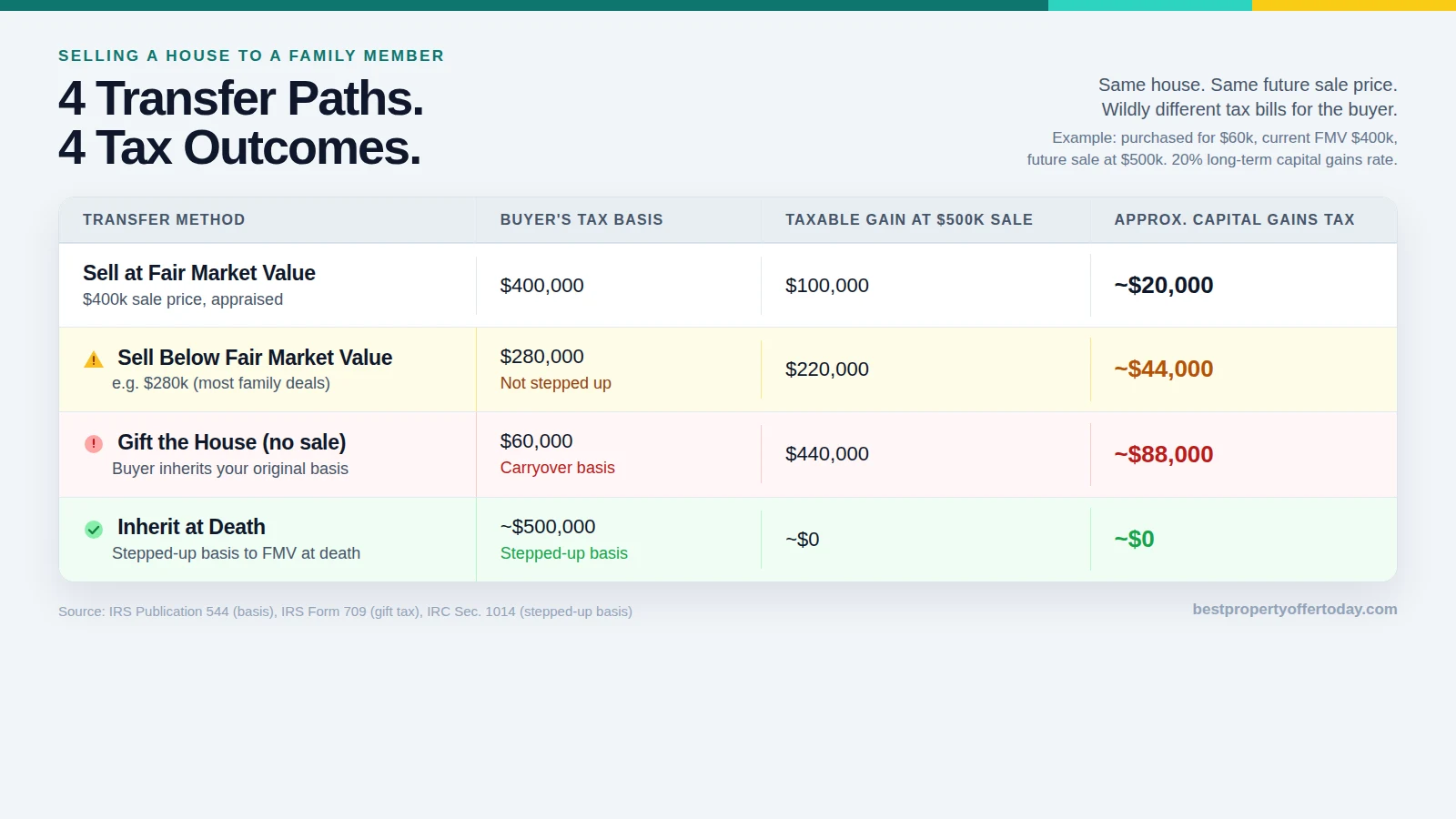
When you sell a property, the buyer’s cost basis is what they paid. That matters because capital gains are calculated from basis. If you sell your house to your son for $280,000 and he later sells it for $500,000, he owes capital gains on $220,000. At the long-term rate of 20 percent, that is roughly $44,000.
Compare that to two alternatives:
- If you give the house as a gift, your son inherits your original cost basis. If you paid $60,000 for the house in 1995, his basis is $60,000. When he sells for $500,000, he owes capital gains on $440,000. That is worse than a discounted sale.
- If you leave the house to him through your estate, he gets a stepped-up basis equal to fair market value on the date you die. If the house is worth $480,000 at that point, his basis is $480,000. When he sells for $500,000, he owes capital gains on $20,000. At 20 percent, that is $4,000 instead of $44,000.
Running those numbers side by side makes clear why some estate attorneys advise against the below-market family sale specifically. The seller sacrifices real money on the sale. The buyer does not get a good basis. The IRS is involved either way.
| Transfer Method | Buyer’s Basis | Taxable Gain at $500k Sale | Capital Gains Tax (20%) |
|---|---|---|---|
| Sell at FMV ($400k) | $400,000 | $100,000 | ~$20,000 |
| Sell below FMV ($280k) | $280,000 | $220,000 | ~$44,000 |
| Gift the house | $60,000 (carryover) | $440,000 | ~$88,000 |
| Inherit at death | ~$500,000 (stepped-up) | ~$0 | ~$0 |
These numbers assume a 20 percent federal long-term capital gains rate and no primary residence exclusion. If the buyer lives in the house as their primary residence for at least two of the five years before selling, they can exclude $250,000 of gain ($500,000 married filing jointly), which changes the math significantly. That’s a question for a tax professional before you agree to a price.
How Financing Changes Everything
If your family member plans to get a mortgage, the lender adds a layer called the identity-of-interest rule. Banks apply extra scrutiny to transactions between related parties because below-market sales can be used to manipulate loan-to-value ratios.
FHA loans require a minimum 25 percent down payment when buyer and seller are related and the property will not be the buyer’s primary residence. For primary residences, standard down payments apply, but the lender will still require a letter of explanation and may require additional documentation.
Conventional loans backed by Fannie Mae and Freddie Mac require an arms-length certification and may apply additional appraisal scrutiny in related-party transactions. Lenders vary in how strictly they apply this, but expect questions.
One structure that works inside lending rules is a gift of equity. Instead of lowering the sale price, the seller formally gifts a portion of the equity as the buyer’s down payment. The house sells at appraised value. The buyer’s mortgage is based on that full price. The gift of equity appears on the closing disclosure as a down payment source.
Worked example: appraisal comes in at $300,000. You want to give your child a $60,000 head start. A gift of equity structures the sale at $300,000, with $60,000 gifted back as down payment. The buyer borrows $240,000. That is 20 percent down on paper, which eliminates private mortgage insurance. Your gift tax situation is identical to a below-market sale, but the lender treats the transaction as arms-length because the sale price equals appraised value.
Cash buyers bypass all of this. No lender, no identity-of-interest review, no appraisal contingency. If your family member is paying cash, skip this section and go straight to the appraisal and attorney questions.
Disclosure Duties Do Not Go Away for Family
Sellers sometimes assume that selling to a relative means they can skip the standard property condition disclosures. That assumption is wrong in every state.
Known defects must be disclosed regardless of who is buying. Courts in most states make no distinction between a family member and a stranger when evaluating failure-to-disclose claims. If you know the basement floods in heavy rain and your nephew closes on the house without that information, you have the same legal exposure you would with any other buyer. The relationship does not create an exception.
Virginia, North Carolina, Georgia, California, and most other states require a written property condition disclosure statement as a matter of law in a residential sale. Consult your state’s real estate commission website or a local attorney for the specific form required.
Selling as-is limits your obligation to repair, not your obligation to disclose. Those are different duties, and conflating them is a common and expensive mistake.
Red Flags to Watch Before You Sign
- No independent appraisal. Without one, the IRS can dispute your claimed fair market value, particularly if the sale price is below the county assessed value.
- Skipping the title search. Family transactions sometimes skip escrow to cut costs. That is how old liens, unreleased mortgages, or boundary problems surface after closing, when they are the buyer’s problem to fix.
- Letting the buyer move in before closing. Lenders treat pre-closing occupancy by the buyer as evidence that the buyer already has an interest in the property, which can disqualify certain loan programs.
- Not telling the other heirs. A below-market sale to one child can be challenged by siblings as an inequitable distribution of your estate, particularly if you die without updating your will or trust to reflect it.
- Skipping a real estate attorney in an attorney state. Connecticut, Delaware, Georgia, Massachusetts, New York, and South Carolina require an attorney for residential closings. Using a title company alone in those states puts the transaction at risk of an unenforceable contract.
- Setting the price without a recent appraisal and then dying. If you sell below FMV and die within three years, the IRS may treat the below-market portion as a deathbed gift and include it in your taxable estate. This is rare but worth knowing if the transaction is large and your health is uncertain.
When Getting Competing Offers First Makes Sense
A cash offer through any channel is typically below what a fully marketed retail sale would bring. That is a true statement about family sales, cash buyers, and iBuyers alike. What matters is whether you know the gap before you agree to anything.
Getting competing offers through a marketplace before settling on a family price gives you a documented reference point that also happens to satisfy the IRS’s fair market value requirement. If the market says $335,000 to $360,000 and your family member is paying $280,000, the discount you are giving them is $55,000 to $80,000. That is a real number to put in front of your family before you sign, not an estimate you invented.
If the house is in good condition and you have time, a traditional listing will almost always net more than a family sale at a discounted price. The right question is whether the relationship and the simplicity are worth the difference. Sometimes they are. Sometimes seeing the number changes what the family member is willing to offer.
Use the net proceeds calculator to estimate what each scenario puts in your pocket after closing costs, mortgage payoff, and carrying time. You can also review the full cash offer versus listing comparison for a worked example with agent commissions, repair costs, and carrying months side by side.
Questions to Ask Before Agreeing to a Family Sale
- Has an independent appraiser established fair market value within the last 90 days?
- Will the buyer finance part of the purchase, and have they confirmed with a lender that they qualify at the agreed price?
- What is your original cost basis in the property? Ask your accountant before agreeing on a price, because the difference between the two figures determines your capital gains exposure.
- Have you told your other heirs about the sale and the price, and have you updated your estate plan to reflect this transaction?
- Are there any liens, judgments, HOA violations, or open permits on the property that will appear in a title search?
- Will you use a real estate attorney and a title company for closing?
- If the buyer is using a mortgage, have they spoken with their lender about the identity-of-interest rules that apply?
Can I sell my house to my child for $1?
Legally, yes. The IRS treats the entire fair market value minus the $18,000 annual exclusion as a taxable gift. On a $300,000 house, that is a $282,000 reportable gift on Form 709, counting against your lifetime exemption. The buyer’s tax basis is $1, so when they eventually sell, they owe capital gains on nearly the entire future sale price. This is rarely the best structure compared to a sale at appraised value or leaving the house through your estate with a stepped-up basis.
Does a family member still need a home inspection?
Not required by law, but strongly recommended regardless of the relationship. A home inspection protects the buyer by uncovering defects the seller may not have known about. It also protects the seller: an inspection report documents the property condition at sale, limiting claims after closing. If the buyer uses an FHA or VA loan, the lender will require an appraisal and may require specific repairs before the loan closes.
Can my family member take over my existing mortgage?
Most conventional loans have a due-on-sale clause requiring full payoff when the property transfers. FHA and VA loans are legally assumable, meaning a qualifying buyer can take over the existing loan and its terms. The Garn-St. Germain Depository Institutions Act prevents due-on-sale enforcement when a property is inherited at death, but that protection does not extend to a sale you complete during your lifetime. Contact your servicer before assuming any mortgage transfer is possible. See the full post on selling a house with an assumable mortgage for the assumption process in detail.
Who pays closing costs when selling to a family member?
The same parties that pay them in any sale. Without agents involved, the 5 to 6 percent in commissions disappears, which is real savings. Recording fees, transfer taxes, title insurance, the title search, and attorney fees remain. Those costs typically run $3,000 to $7,000 depending on state and sale price. Plan for them on both sides. For a full breakdown of what the seller typically covers, see the closing costs in a cash sale post.
Questions about how a family transaction compares to other options: call 804-361-7460 or run your numbers through the proceeds calculator first.
Ready to see real numbers for your house?
Enter your property address to get competing offers from verified cash buyers. No repairs, no agent fees, and you pick the closing date.
Prefer to talk? Call (804) 361-7460