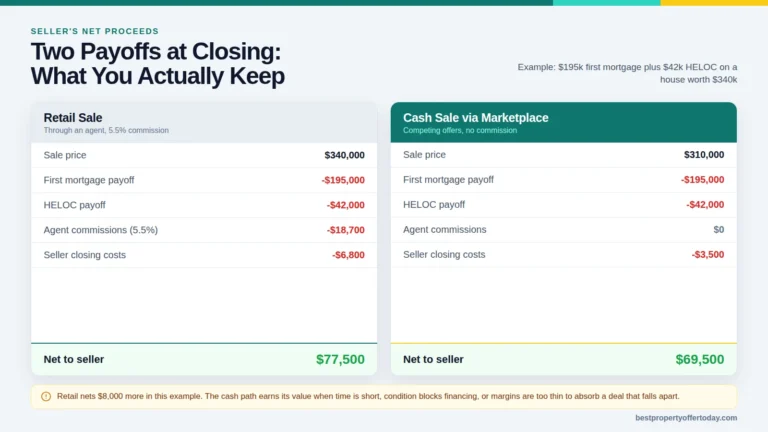
Most cash offers land somewhere between 70 and 85 percent of what your home would sell for on the traditional real estate market, which means you can expect a discount of 15 to 30 percent. That range depends on your home’s condition, market demand, and how many competing offers you compare.
The key question is not whether the offer will be lower, but whether that lower number still makes sense given the trade-offs you gain by selling for cash.
Why Cash Offers Are Always Lower Than Market Price
A cash buyer is taking on multiple costs and risks that a traditional home buyer does not carry. When you sell through a realtor, the buyer’s mortgage lender is doing the heavy lifting of due diligence, inspection, and appraisal. When you accept a cash offer, the buyer assumes those responsibilities themselves, plus the cost and risk of fixing whatever repairs your home needs.
That means a cash buyer has to account for:
- Repair and renovation costs if your home needs work
- Holding costs while the property is being fixed and resold or rented
- Closing costs, title insurance, and legal fees they pay directly
- Market risk between the time they buy and when they resell or lease it
- Profit margin they need to make the deal worth their time and capital
Every one of those costs reduces the price they can offer you. That is why cash offers are structurally lower than what you would get on the open market.
What Determines Your Specific Discount?
The exact percentage discount on your home depends on a handful of factors:
Home Condition
If your home is in excellent condition and needs minimal repairs, the discount is smaller, often closer to 15 to 20 percent below market. If your home needs significant work, cosmetic updates, or carries structural concerns, the discount can push toward 25 to 30 percent or even lower.
Market Speed and Demand
In a fast-moving market where homes sell quickly, cash buyers know they can turn a property around faster, which lowers their holding costs and risk. In a slower market, buyers need a bigger discount to justify the wait. Your local real estate market speed directly impacts how much lower a cash offer will be.
Number of Offers You Compare
If you only get one cash offer, you have no idea whether you landed at the high end or low end of what your home is actually worth to investors. If you get three or four competing offers, you can see the range and negotiate or accept the best one. Most sellers who compare multiple cash offers end up with offers that are 5 to 15 percent higher than a single lowball offer.
What You Get in Return for That Discount
The discount is real, but so are the benefits you gain when you accept it. Understanding the full picture helps you decide whether the trade-off is worth it.
When you sell for cash, you get:
- Speed: Most cash deals close in 7 to 14 days instead of 30 to 60 days
- Certainty: No appraisal contingencies, no mortgage lending drama, no last-minute deal collapses
- No repairs required: You sell as-is, the buyer handles all the work
- No agent commissions: You save the 5 to 6 percent typically paid to realtors
- No showings or open houses: Your privacy is protected from day one
- Predictable timeline: You know exactly when you will close and when funds will hit your account
For many sellers facing job relocations, divorce, probate, foreclosure, or simply wanting to move quickly without the hassle of traditional selling, those benefits are worth far more than the 15 to 30 percent discount.
I was getting ready to move for a new job and didn’t have time to list the house and wait for a buyer. The cash offer was lower than what a realtor said it might fetch, but I closed in 10 days without any surprises. That speed and certainty were worth every penny of the discount.
How to Make Sure You Are Getting Fair Value
The discount is real, but it should not feel like you are being taken advantage of. Before accepting a cash offer, do these three things:
- Get multiple offers: Compare at least two or three cash offers. The differences between them can be significant.
- Ask about the math: Request that each buyer explain what comps they used, what repairs they estimate, and how they arrived at their offer price. Reasonable answers matter.
- Know the local cash market: If you have friends or family who sold for cash recently, ask what percentage of market value they received. That gives you a local benchmark.
For a deeper look at exactly how cash buyers calculate their offers, including a full worked example with real numbers, see our guide on how much less you get selling to a cash buyer. And if you are deciding between a cash sale and the traditional market, read our comparison on whether to sell to a we buy houses company.
Ready to See What Your Home Is Worth?
Get your free cash offer and see exactly what investors in your area are willing to pay. When you compare multiple offers, you can decide whether the discount is worth the speed and certainty you gain.
Frequently Asked Questions
What is a typical cash offer percentage of market value?
Most cash offers land between 70 and 85 percent of full market value, or a discount of 15 to 30 percent, depending on home condition and local market demand.
Why is a cash offer always lower than listing price?
Because the cash buyer takes on all repair costs, holding costs, and market risk that a traditional mortgage lender does not carry.
Can I negotiate a cash offer upward?
Yes. Get multiple offers and ask buyers to explain their math. If repairs are less than they estimated or if you have strong competing offers, there may be room to negotiate.
Is the cash discount worth it for a fast sale?
That depends on your timeline and situation. If you need to move quickly or avoid the hassle of traditional selling, the discount is often worth it. If you have time, listing traditionally may get you a higher price.
How do I know if a cash offer is fair?
Compare multiple offers and ask each buyer what comps and repair estimates they used. If all buyers arrive at similar numbers, the offer is likely fair. If one is significantly different, dig into why.