Selling to a cash home buyer typically nets you somewhere between 70% and 90% of your home’s fully renovated market value, depending on its condition and how many offers you compare. The exact number comes down to a formula most cash buyers use, and once you understand it, you can tell whether an offer is fair or a lowball.
How Cash Buyers Actually Calculate Their Offers
Most cash buyers start with recent comparable sales, often called comps, from the last 90 days within about a 5 mile radius of your property. The first thing they check is how that comp actually sold.
- If the comp sold on the MLS to a retail buyer, meaning a family who plans to live in it, the buyer typically deducts roughly 6% off that sale price to account for the agent commissions the seller paid, since that cost is baked into the retail number.
- If the comp sold directly to an investor, that number is already close to what an investor would pay for a similar property, so less adjustment is needed.
That gives a baseline for what a similarly conditioned home is worth to an investor buyer in your specific area.
Adjusting for Condition
Here is where it gets more specific. If the best comps available are in better shape than your home, cash buyers do not just use that number outright. Instead, they typically take a comp with the same bedroom count, bathroom count, and square footage, apply somewhere around 70% to 80% of that value, and then subtract the actual cost of repairs your home needs.
A Real Example, Start to Finish
Let’s walk through this with real numbers so the math is completely clear.
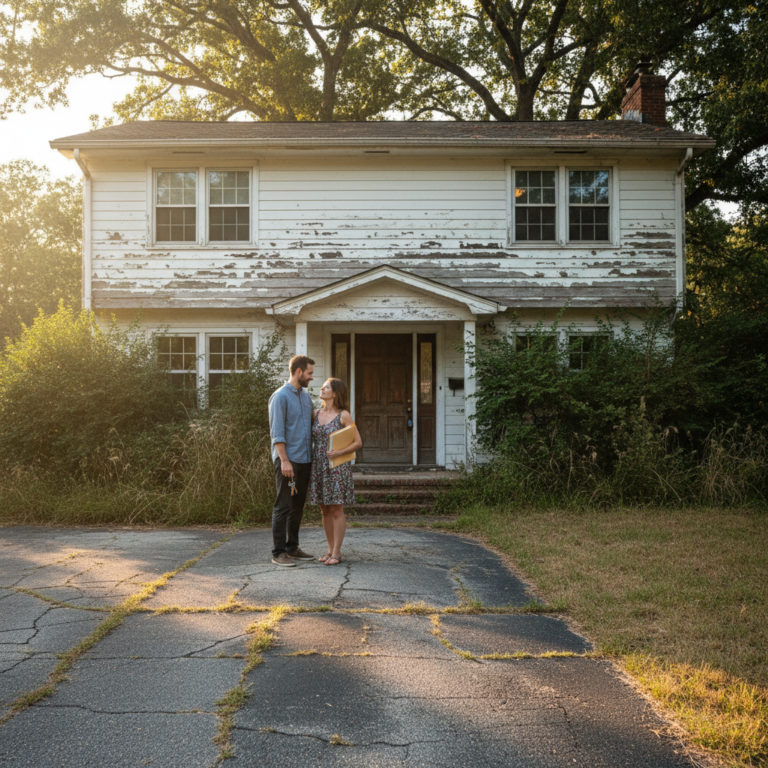
Say a fully renovated 3-bedroom, 2-bathroom home just down the street sold for $320,000. Your home has the same layout and square footage, but it needs real work: a new roof at $14,000, both bathrooms fully redone at $10,000 each for $20,000 total, an outdated kitchen that needs a full remodel at $25,000, plus flooring, HVAC repairs, and general deferred maintenance that adds up to another $15,000. That comes to $74,000 in real, itemized repair costs.
Start with the $320,000 comp and apply the 70% to 80% range for the difference in condition.
- 70% of $320,000 equals $224,000
- 80% of $320,000 equals $256,000
Now subtract the $74,000 in repair costs from each end of that range.
- $224,000 minus $74,000 equals $150,000
- $256,000 minus $74,000 equals $182,000
So a reasonable cash offer on this property would land somewhere between roughly $150,000 and $182,000, depending on the buyer’s risk tolerance and how quickly they plan to resell or rent the property afterward. That is a wide range, and it is exactly why getting only one offer can cost you tens of thousands of dollars.
Why the Range Between Buyers Can Be So Different
Some buyers apply a stricter deduction if they are less experienced with major renovations, or if their financing costs run higher. Others are more aggressive with their offer if they have a contractor relationship that gets repairs done for less than average. This is the real reason two cash offers on the exact same house can differ by $20,000 or more, even when both buyers looked at the same comps.
Location also plays a role. In fast-moving markets, buyers may offer closer to the 80% end because they expect to resell quickly. In slower markets, or on properties with major structural issues, offers tend to land closer to 70% since the buyer is taking on more risk and holding costs.
What This Means for You as a Seller
If you only get one offer, you have no way of knowing whether you landed near the $150,000 end of that range or closer to $182,000. Comparing multiple offers side by side is the only real way to find out where your specific buyer landed, and whether their number reflects a fair read on your repairs or an overly conservative one.
I got an offer from one of those roadside we buy houses signs and it felt way too low. Once I compared it through Best Property Offer Today, the second offer came in almost $30,000 higher for the exact same house. I had no idea how much that first offer left on the table.
How to Make Sure You Are Not Leaving Money on the Table
- Get more than one cash offer before you decide, since the math above shows just how wide that range can be
- Ask each buyer what comps they used and how they arrived at their repair estimate
- Get a rough repair estimate of your own, even a ballpark number from a contractor, so you know if a buyer’s deduction is realistic
- Remember that a lower offer is not automatically wrong, some homes genuinely need more work than sellers realize going in
Get a Real Number for Your Home
Compare cash offers today and see exactly what buyers are willing to pay once they run the real numbers on your property, not just a rough estimate. If you are also weighing whether repairs are worth it before you sell, our guide on selling a house as-is breaks down that decision, and if you are comparing cash buyers to iBuyers like Opendoor, see how the numbers stack up in our Opendoor alternatives guide.
Frequently Asked Questions
How much less is a cash offer than market value?
Typically 70% to 90% of the fully renovated market value, depending on your home’s condition and how many offers you compare.
Why do cash buyers subtract repair costs from the offer?
Because they are taking on the cost and risk of fixing the property themselves after closing, so those repair dollars come directly out of the price they can pay you.
Can I negotiate a cash offer if I think it is too low?
Yes. Ask what comps and repair estimate the buyer used, and get a second opinion. If your repairs cost less than they estimated, there may be room to negotiate.
Do all cash buyers use the same formula?
No. The comps-and-repairs approach is common, but the exact percentages and adjustments vary by buyer, which is why offers can differ significantly between companies.
Is it worth getting multiple cash offers?
Yes. Since the acceptable range on a typical home can span $20,000 to $30,000 or more, comparing offers is the only way to know you are getting a fair number.