Fire Damage Insurance Proceeds: Who Keeps the Money When You Sell?
The insurance money from a house fire stays with you, not the property. When you sell a fire-damaged home, the claim you filed belongs to you as the policyholder at the time of the loss. Two things complicate that: your mortgage lender and your policy type. Both determine how much you actually collect, and when.
Understanding the mechanics before you list or accept an offer can protect tens of thousands of dollars. Here is how each piece works.
The Basic Rule: Proceeds Follow the Insured, Not the Property
Homeowner insurance is a contract between you and your insurer. The claim is yours. Selling the property does not transfer that contract to the buyer and does not cancel what you are owed.
If you filed a claim before selling, you keep the right to collect it. If you sell before filing, the claim becomes much harder to make: your insurable interest ends at closing, and most insurers require that you owned the property at the time of the loss. File before you sell, even if repairs are not on the table.
The complication most sellers run into is not ownership of the proceeds. It is the lender.
Why a Mortgage Complicates the Payout
If you have a mortgage, your lender is almost certainly listed on your insurance policy as a “mortgagee.” That language means the insurer must protect the lender’s security interest in the property. In practice, the settlement check is co-payable: your name and the lender’s name, both required to cash it.
The lender will not endorse that check unless one of two things happens:
- You use the money to repair the property, restoring the collateral the loan is secured against
- The mortgage is paid off in full, releasing the lender’s claim on the proceeds
In a straightforward cash sale, the sale itself pays off the mortgage at closing. Once the lender receives their payoff, they release their interest in the property and in the insurance proceeds. The insurance check becomes yours to keep, separate from what the sale nets you.
If the sale price does not cover the mortgage balance, you are looking at a short sale. That requires lender approval and a separate negotiation about how insurance money gets divided. It is a longer, more complex process and outside the scope of a standard as-is sale.
ACV vs. RCV Policies: The Holdback Problem
Your policy type determines whether you collect the full claim or lose access to part of it when you sell without repairing first.
Most homeowner policies are Replacement Cost Value (RCV). These pay in two stages. First, the insurer sends the Actual Cash Value (ACV) amount, which is the replacement cost minus depreciation. That payment arrives first and relatively quickly. The second payment, called the holdback or depreciation recovery, arrives only after repairs are complete and you submit contractor documentation.
If you sell without making repairs, you collect the ACV and forfeit the holdback. On a $90,000 fire claim, the ACV might be $67,000 and the holdback $23,000. Selling without repairing means $23,000 that the policy would otherwise pay never reaches you. This is one of the most commonly missed costs in a fire damage sale, because sellers assume the insurer’s initial estimate is the full payment.
Actual Cash Value policies pay in a single lump sum with no holdback requirement. If you have an ACV policy, there is no repair penalty for selling as-is. ACV policies are less common on primary residences because they pay less overall, but confirm which type you carry before agreeing to any sale structure.
A Worked Example: Two Paths, Real Numbers
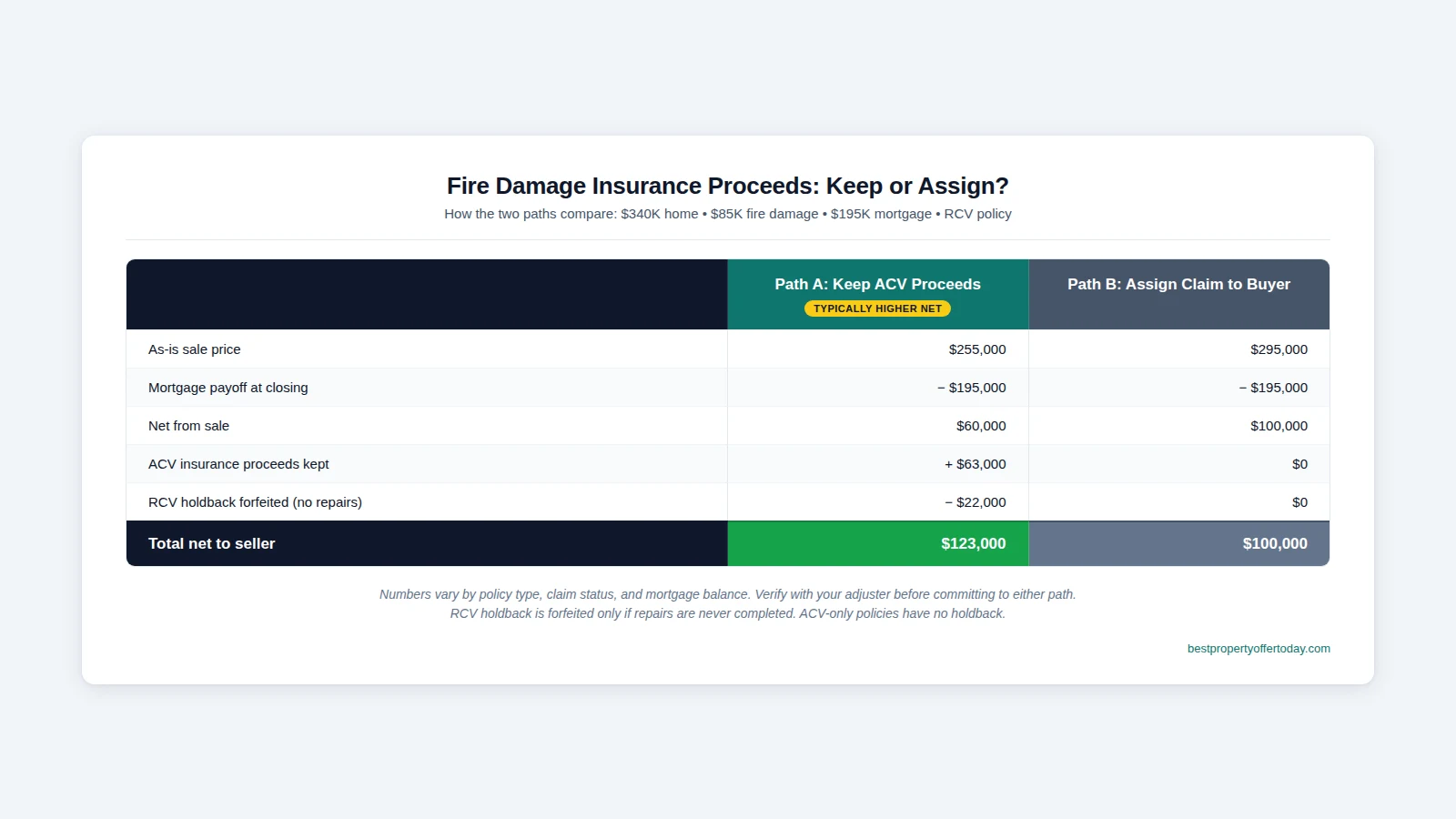
Assume a house worth $340,000 before a kitchen fire. The fire causes $85,000 in structural and smoke damage. The seller carries a $195,000 mortgage and an RCV policy. The insurer has issued the ACV check of $63,000. The holdback of $22,000 is still pending and requires completed repairs to release.
Path A: Keep the ACV proceeds, sell as-is.
| Item | Amount |
|---|---|
| As-is sale price | $255,000 |
| Mortgage payoff at closing | – $195,000 |
| Net from sale | $60,000 |
| ACV check already received | + $63,000 |
| Total in seller’s pocket | $123,000 |
Note: The $22,000 RCV holdback was never collected. It is not subtracted from the above, it simply was never received. Repairing before selling would have unlocked it.
Path B: Assign the full insurance claim to the buyer in exchange for a higher sale price.
| Item | Amount |
|---|---|
| Sale price (claim premium included) | $295,000 |
| Mortgage payoff at closing | – $195,000 |
| Net from sale | $100,000 |
| Insurance proceeds retained | $0 |
| Total in seller’s pocket | $100,000 |
Path A produces $23,000 more for the seller in this scenario. The buyer pricing Path B is paying a $40,000 premium over the as-is price ($295K vs $255K) for a claim that could pay out $63,000 in ACV plus potentially $22,000 in holdback after their repairs. They are not paying full insurance value as a premium because they bear the claim administration risk and the cost of repairs to unlock the holdback. The seller loses the holdback either way on Path A, but gains on the lower purchase price the buyer accepts.
These numbers shift based on how much of the claim has already been paid, your mortgage balance, and how aggressively the buyer prices damaged properties. Have a licensed public adjuster assess your claim value before deciding which structure to accept.
Selling With an Open Claim: Three Workable Approaches
If your claim is not settled when you sell, you have three paths:
Retain the claim and close. Your attorney notes in the purchase agreement that you are keeping the insurance claim. The buyer takes the property as-is at an agreed price. You continue pursuing the claim after closing. Most insurers will honor this as long as your insurable interest was intact at the time of the loss. Clear written language in the purchase contract is the prerequisite.
Wait for settlement, then sell. You know exactly what you will receive before pricing the sale. The cost is time: carrying a damaged property you cannot occupy while the claim works through the insurer’s process. Large structural claims can take months to settle, and some stall further when the seller and insurer disagree on scope.
Assign the claim to the buyer at closing. The purchase agreement includes a formal written assignment. The insurer must be notified and may require their own documentation. Some insurers resist assignments; others require the process to be complete before closing. An attorney must draft the assignment clause. An oral agreement to hand over a claim is not enforceable and creates liability for both parties.
For most sellers working with a cash buyer, the first path is the cleanest. The buyer’s business is purchasing and repairing damaged property, not administering claims on policies they do not own.
Disclosure You Cannot Skip
Selling as-is does not eliminate your disclosure obligations. Every state requires sellers to disclose known material defects, and fire damage qualifies. An open insurance claim is disclosable in most states as well. Failure to disclose creates fraud exposure that follows you after closing, regardless of what the purchase agreement says about as-is condition.
Give the buyer a written disclosure stating the fire date, the extent of damage as you know it, the status of any claim, and whether any repairs have been made. Have an attorney review the disclosure form before you sign anything. This protects you, not just the buyer.
Red Flags When a Buyer Pushes Hard for Claim Assignment
Some buyers who specialize in damaged properties prefer to manage the insurance claim themselves. That is a legitimate approach. Watch for these signs that something is off:
- A high sale price contingent on assigning a claim you have not yet been paid on
- Pressure to close before the insurer acknowledges or approves the assignment in writing
- A purchase agreement inflating the assigned claim value in the headline price, with no escrow protection if the insurer later reduces it
- No time offered to consult an attorney before signing
A legitimate buyer will accept your keeping the claim and adjust their offer price accordingly. If the only structure on the table requires handing over the claim, get a second offer before deciding. Our guide to evaluating cash buyers covers the questions worth asking before you sign anything.
The Honest Picture: What a Cash Sale Nets on Fire-Damaged Property
A cash offer on a fire-damaged property is nearly always below what you would net from a full repair and traditional listing. What the seller gives up is the gap between as-is value and repaired market value. What the seller gets in exchange is certainty: no contractor to coordinate, no draw schedule to fight through with the insurer and the lender, no months carrying a property with no habitability, no retail buyer financing collapsing because the house fails appraisal on a damaged-property inspection.
If the house had solid equity before the fire and the damage is repairable at a manageable cost, fixing it and listing with an agent will typically produce a higher total. That path takes six months to a year in most cases and requires either out-of-pocket repair funding or a supervised draw process coordinated among you, your lender, and a licensed contractor. The lender controls the draw, the contractor sets the schedule, and you carry the property through all of it.
If time and certainty matter more than maximum price, comparing competing cash offers from vetted buyers first gives you a real baseline before committing to the repair path. To see what you stand to net after insurance, mortgage payoff, and closing costs, use the net proceeds calculator. It handles as-is scenarios and takes less than two minutes.
For a broader look at your options after a fire, including what cash buyers evaluate and how the general sale process works, see the companion post on selling a fire-damaged house.
To collect competing offers from vetted buyers on your property, submit your details at bestpropertyoffertoday.com. The service is free, there is no obligation to accept any offer, and offers typically come back within 24 to 48 hours. You can also call 804-361-7460 to discuss your situation before submitting.
Can I keep my insurance check and still sell the house as-is?
Yes, in most cases. Insurance proceeds belong to you as the policyholder at the time of the loss. Selling the property does not cancel that right. If the mortgage is paid off through the sale, the lender’s co-payee interest on the check is released and the money is yours to keep, independent of what the sale itself produces.
What if the insurance check names my lender?
Most checks on mortgaged properties are co-payable to the lender. If the sale pays off the mortgage, the lender endorses the insurance check at closing. If the sale price falls short of the mortgage payoff, you need the lender’s cooperation on the insurance proceeds separately. Talk to the lender before you accept any purchase offer.
Can I sell before the insurance claim settles?
Yes. You can close on a sale with the claim still open, as long as the purchase agreement clearly states you are retaining the claim. Notify your insurer in writing that the property has sold and the claim remains in your name. An attorney letter to the insurer helps move this along. Some insurers are straightforward about continuing the claim with the prior owner; others ask for additional documentation before proceeding.
What happens to the holdback if I sell without repairing?
On an RCV policy, the holdback is forfeited if repairs are never completed. The insurer will not release the depreciation recovery without documentation of finished work from a licensed contractor. On a large claim, this can represent a significant portion of the total settlement. Confirm with your adjuster exactly how much holdback is still pending before you commit to an as-is sale.